PART 12 — STRATEGIC SYNTHESIS & MARKET ARCHITECTURE
WEALDRAED THRYMMELLEN
Email: info@wealdraedthrymmellen.org
Phone: +971 58 540 3888
Downloadable link: https://drive.google.com/uc?export=download&id=16huleqgxU2FkY8RIyn-J50JVIdUAXGvs
Report Period: January – April 2026
Published: May 2026
Sources: S&P Global Platts · Argus Media · LME · CBOT · Baltic Exchange · EIA · IEA · USDA · World Bank · LBMA · OPEC · FAO · ISCC · wealdraedthrymmellen.org
12.1 THE COMMODITY SYSTEM IN Q1 2026
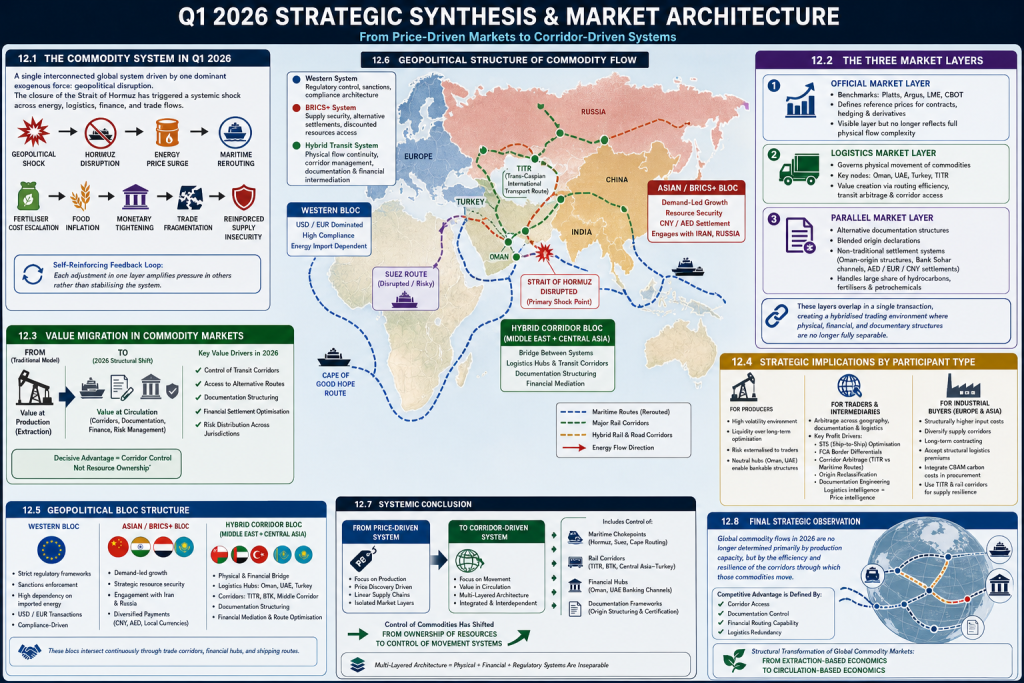
The commodity system in Q1 2026 can no longer be understood as a set of isolated markets. It now operates as a single interconnected global system driven by one dominant exogenous force: geopolitical disruption.
The closure of the Strait of Hormuz has acted as a systemic shock that propagates simultaneously across energy, logistics, finance, and physical trade flows. These four layers are now structurally interdependent rather than sequential.
The transmission mechanism is best understood as a cascading chain:
Geopolitical shock → Hormuz disruption → Energy price surge → Maritime rerouting → Fertiliser cost escalation → Food inflation → Monetary tightening → Trade fragmentation → Reinforced supply insecurity
This feedback loop is self-reinforcing, meaning that each adjustment in one layer amplifies pressure in the others rather than stabilising the system.
12.2 THE THREE MARKET LAYERS
Global commodity flows in 2026 operate across three parallel but interconnected layers:
1. Official Market Layer
This layer includes benchmark pricing systems such as Platts, Argus, LME, and CBOT. It defines reference prices used in contracts, hedging instruments, and financial derivatives. It remains the “visible” market layer but no longer reflects full physical flow complexity.
2. Logistics Market Layer
This layer governs physical movement of commodities through corridors, ports, and transit hubs. Key nodes include Oman, UAE, Turkey, and the Trans-Caspian (TITR) corridor. Value creation increasingly occurs through routing efficiency, transit arbitrage, and corridor access rather than production alone.
3. Parallel Market Layer
This layer includes alternative documentation structures, blended origin declarations, and non-traditional settlement systems. Examples include Oman-origin documentation structures, Bank Sohar facilitation channels, and hybrid settlement mechanisms in AED, EUR, and CNY. This layer now handles a significant proportion of Middle Eastern hydrocarbons, fertilisers, and petrochemicals.
These three layers frequently overlap within a single transaction, creating a hybridised trading environment where physical, financial, and documentary structures are no longer fully separable.
12.3 GEOPOLITICAL BLOC STRUCTURE
The global commodity system is increasingly structured around three overlapping geopolitical blocs:
Western Bloc
Characterised by strict regulatory frameworks, sanctions enforcement mechanisms, and high dependency on imported energy. Transactions are predominantly USD/EUR denominated and heavily compliance-driven.
Asian / BRICS+ Bloc
Characterised by demand-led growth, strategic resource security, and continued engagement with sanctioned producers such as Iran and Russia. Payment systems are increasingly diversified, including CNY and AED settlement channels.
Hybrid Corridor Bloc (Middle East + Central Asia)
This bloc functions as the physical and financial bridge between systems. It includes logistics hubs (Oman, UAE, Turkey) and transit corridors (TITR, BTK, Middle Corridor). It plays a critical role in documentation structuring, financial mediation, and route optimisation.
12.4 VALUE MIGRATION IN COMMODITY MARKETS
A fundamental structural shift has occurred in 2026: value creation has migrated from production to circulation.
In earlier commodity cycles, value was primarily concentrated at the extraction or production stage. In the current cycle, value is increasingly captured through:
- Control of transit corridors
- Access to alternative shipping routes
- Documentation structuring and origin management
- Financial settlement optimisation
- Risk distribution across jurisdictions
In this environment, the decisive advantage is no longer resource ownership, but corridor control.
The most critical competitive capability is now the ability to move commodities efficiently through constrained and fragmented global logistics systems.
12.5 STRATEGIC IMPLICATIONS BY MARKET PARTICIPANT TYPE
For Producers:
Producers operate in a high-volatility pricing environment where immediate liquidity is prioritised over long-term optimisation. Risk is increasingly externalised to traders and logistics intermediaries. Neutral jurisdictions such as Oman and the UAE play a central role in enabling bankable transaction structures.
For Traders and Intermediaries:
Trading value is increasingly generated through arbitrage across geography, documentation structures, and logistics constraints. Key profit drivers include:
- STS (ship-to-ship) optimisation
- FCA border pricing differentials
- Corridor arbitrage (TITR vs. maritime routes)
- Origin reclassification and documentation engineering
In this environment, logistics intelligence is as valuable as price intelligence.
For Industrial Buyers (Europe & Asia):
Industrial buyers face structurally higher input costs driven by energy volatility and logistics fragmentation. Key strategic responses include:
- Diversification across multiple supply corridors
- Long-term contracting to reduce exposure to spot volatility
- Acceptance of structural logistics premiums
- Integration of CBAM carbon costs into procurement models
- Use of TITR and rail-based corridors for supply resilience
European buyers in particular face additional carbon pricing pressure under CBAM, reinforcing the cost gap between low- and high-carbon supply chains.
12.6 GEOPOLITICAL STRUCTURE OF COMMODITY FLOW
The global commodity system now operates across three overlapping geopolitical realities:
Western System:
Focused on regulatory control, sanctions enforcement, and financial compliance architecture.
BRICS+ System:
Focused on supply security, alternative settlement systems, and continued access to discounted hydrocarbons and fertilisers.
Hybrid Transit System:
Focused on enabling physical flow continuity through corridor management, documentation restructuring, and financial intermediation.
These systems do not operate independently; instead, they intersect continuously through trade corridors, financial hubs, and shipping routes.
12.7 SYSTEMIC CONCLUSION
The Q1 2026 commodity environment represents a transition from a price-driven system to a corridor-driven system.
The defining structural shift is as follows:
Control of commodities has shifted from ownership of resources to control of movement systems.
This includes:
- Maritime chokepoints (Hormuz, Suez, Cape routing)
- Rail corridors (TITR, BTK, Central Asia–Turkey routes)
- Financial hubs (Oman, UAE banking channels)
- Documentation frameworks (origin structuring and certification systems)
As a result, the commodity system has evolved into a multi-layered architecture where physical, financial, and regulatory systems are inseparable.
12.8 FINAL STRATEGIC OBSERVATION
The dominant structural reality of 2026 is that global commodity flows are no longer determined primarily by production capacity, but by the efficiency and resilience of the corridors through which those commodities move.
In this environment, competitive advantage is defined by:
- Corridor access
- Documentation control
- Financial routing capability
- Logistics redundancy
This marks a structural transformation of global commodity markets from extraction-based economics to circulation-based economics.