
Building a Cross-Border SPV Fund Architecture (2026): An Institutional Approach
WEALDRAED THRYMMELLEN
Email: info@wealdraedthrymmellen.org
Phone: +971 58 540 3888
Download link: https://drive.google.com/uc?export=download&id=1K7wLEviiFkPeC8pF6YOwGpt2lRnpnV3q
Report Period: January – April 2026
Published: May 2026
Sources: S&P Global Platts · Argus Media · LME · CBOT · Baltic Exchange · EIA · IEA · USDA ·World Bank · LBMA · OPEC · FAO · ISCC · wealdraedthrymmellen.org
Introduction: Why This Structure Exists
Global investment structures are no longer about simply reducing tax or adding jurisdictions. In 2026, the reality is different:
- Regulators are focused on substance and control
- Banks are focused on clarity and risk
- Investors (LPs) are focused on transparency and governance
Most offshore structures fail because they try to do everything at once, privacy, tax efficiency, and scale, without aligning these with institutional expectations.
This structure solves that problem.
It is designed to achieve three outcomes simultaneously:
- Preserve ownership privacy at the top level
- Demonstrate real economic substance at the operational level
- Provide a clean, auditable path for institutional capital
In simple terms:
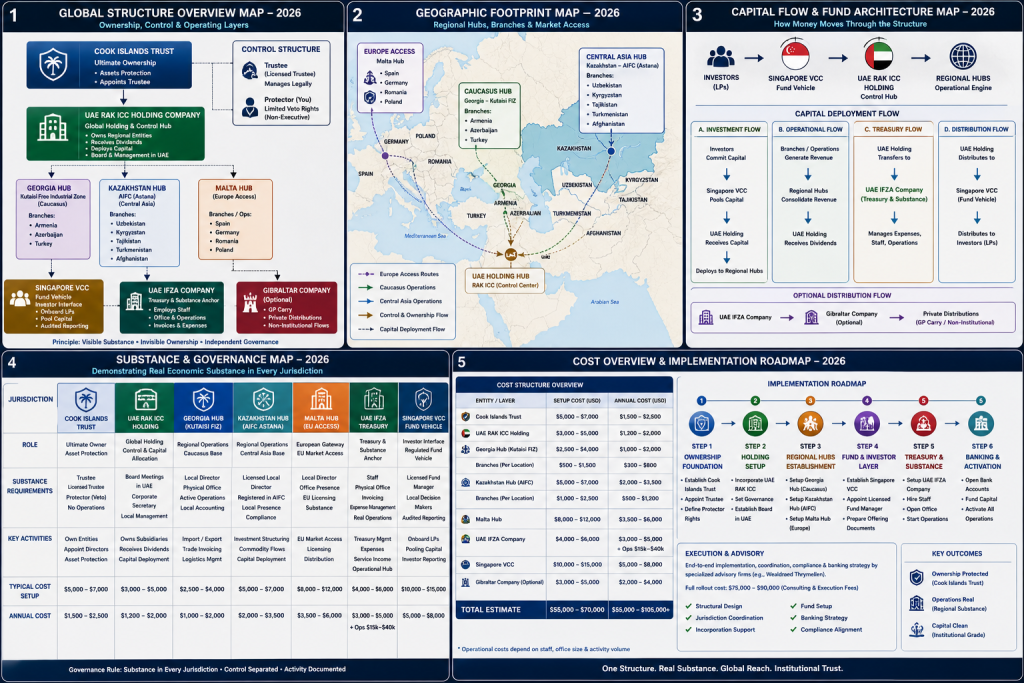
Ownership is protected, operations are real, and capital flows are clean.
The Core Principle
The entire structure is built on one idea:
Visible substance, invisible ownership, independent governance
Everything flows from this.
Step 1: Establishing Ultimate Ownership
At the top sits a Cook Islands Trust.
This is not an operational entity. It does not trade, invoice, or interact with banks directly.
Its purpose is singular:
- To own all entities in the structure
- To appoint directors through a licensed trustee
- To protect assets and maintain long-term control
Control is split deliberately:
- The Trustee manages everything legally
- The Protector (you) has limited veto rights only
This separation is critical. It prevents regulators from classifying you as a “shadow director,” which is one of the most common reasons structures fail under scrutiny.
Typical cost:
- Setup: approximately $5,000-$7,000
- Annual maintenance: approximately $1,500-$2,500
Step 2: Creating the Global Holding Layer
The next layer is a UAE RAK ICC holding company.
This entity sits directly under the trust and acts as the central control hub.
Its role is to:
- Own all regional operating companies
- Receive dividends
- Deploy capital into markets
However, unlike older offshore models, this entity cannot remain passive.
To be compliant in 2026, it must demonstrate management and control:
- Board meetings must occur in the UAE
- A corporate secretary must be in place
- Strategic decisions must be documented locally
This prevents tax authorities (for example in France) from claiming that the structure is actually managed elsewhere.
Typical cost:
- Setup: approximately $3,000-$5,000
- Annual maintenance: approximately $1,200-$2,000
Step 3: Building Real Regional Operations
This is where the structure becomes economically meaningful.
Instead of creating many standalone companies, the model uses regional hubs with branch expansion.
Caucasus Operations, Georgia (Kutaisi Free Industrial Zone)
The Georgian entity acts as a master company for the Caucasus region.
It handles:
- Import/export activity
- Trade invoicing
- Logistics coordination
From this base, branches extend into:
- Armenia
- Azerbaijan
- Turkey
These are not separate companies but operational extensions. Revenue is consolidated in Georgia, where the tax environment is highly efficient.
To remain compliant, this entity must show real presence:
- A local director
- A physical office
- Active operations (even if lean)
Typical cost:
- Setup: $2,500-$4,000
- Annual: $1,000-$2,000
- Each branch: $500-$1,500 setup, with minimal annual costs
Central Asia Operations, Kazakhstan (AIFC)
Kazakhstan’s Astana International Financial Centre acts as the legal and financial hub for Central Asia.
This entity operates under English common law and is ideal for:
- Investment structuring
- Commodity flows
- Regional capital deployment
From here, branches extend into:
- Uzbekistan
- Kyrgyzstan
- Tajikistan
- Turkmenistan
- Afghanistan
Again, these are controlled as extensions, not separate corporate burdens.
Substance requirements include:
- A licensed local director
- Local compliance and accounting
- Registered presence within AIFC
Typical cost:
- Setup: $5,000-$7,000
- Annual: $2,000-$3,500
- Branch expansion: $1,000-$2,500 per location
European Access, Malta Hub
For Europe, a single gateway is used: Malta.
This entity provides:
- Access to EU markets
- Licensing capability
- Tax treaty benefits
From Malta, operations can extend into:
- Spain
- Germany
- Romania
- Poland
These can be structured as branches or operational extensions depending on scale.
Typical cost:
- Setup: $8,000-$12,000
- Annual: $3,500-$6,000
Step 4: Creating the Investor Interface
Institutional investors do not invest into offshore holdings. They invest into regulated vehicles.
This is why the structure includes a Singapore Variable Capital Company (VCC).
The VCC is separate from the UAE holding and serves as the official fund layer.
Its role is to:
- Onboard LPs (limited partners)
- Pool capital
- Provide audited reporting
- Maintain regulatory credibility
Capital flows as follows:
- Investors commit funds to the VCC
- The VCC deploys capital into the UAE holding
- The holding allocates capital to regional operations
The VCC must be managed by a licensed fund manager with real decision-making authority.
This ensures the structure is not seen as controlled informally.
Typical cost:
- Setup: $10,000-$15,000
- Annual: $5,000-$8,000
Step 5: Establishing a Treasury and Substance Anchor
A critical addition is a UAE IFZA company.
This is not just another entity, it is the economic core of the structure.
It must:
- Employ staff
- Hold a physical office
- Manage expenses
- Issue invoices
It receives:
- Management fees
- Service income
- Operational transfers
And pays:
- Salaries
- Contractors
- Administrative costs
This entity proves to regulators that the structure is not a shell.
Typical cost:
- Setup: $4,000-$6,000
- Annual: $3,000-$5,000
- Operational costs (staff and office): $15,000-$40,000
Step 6: Optional Distribution Layer
A Gibraltar entity can be added, but only for limited purposes:
- GP carry
- Private distributions
- Non-institutional flows
It should never be used for investor payouts.
This preserves banking relationships and avoids unnecessary scrutiny.
Typical cost:
- Setup: $3,000-$5,000
- Annual: $2,000-$4,000
How the Capital Actually Moves
The structure works because the flow of money is simple and auditable.
Investment:
Investors → Singapore VCC → UAE Holding → Regional Operations
Operations:
Branches → Regional Hubs → UAE Holding
Treasury:
UAE Holding → UAE IFZA
Distribution:
UAE Holding → Singapore VCC → Investors
Optional:
UAE IFZA → Gibraltar → Private distributions
Total Cost Overview
To implement the full structure:
Initial setup typically falls between:
- $55,000 and $70,000
Annual running costs generally range from:
- $55,000 to $105,000, depending on staffing and activity level
Execution and Advisory
End-to-end implementation, including structuring, coordination, and compliance setup, is typically handled by specialized advisory firms such as Wealdraed Thrymellen.
A full rollout, covering trust formation, holding setup, regional entities, fund structure, and banking architecture, usually requires:
- $75,000 to $90,000 in consulting and execution fees
This includes:
- Structural design
- Jurisdiction coordination
- Incorporation support
- Fund setup
- Banking strategy
- Compliance alignment
Final Perspective
This is not an offshore structure in the traditional sense.
It is a multi-jurisdictional operating system.
- The trust protects ownership
- The UAE centralizes control
- Regional hubs generate revenue
- Singapore legitimizes capital
- UAE IFZA proves substance
And everything connects through one clean, auditable loop.
Closing Thought
The difference between a structure that works and one that fails is not complexity, it is alignment.
This model aligns ownership, operations, and capital in a way that satisfies regulators, banks, and investors at the same time.
That is what makes it scalable.